This article explains in plain English how to use the Spanish verbs Tener and Deber in the present tense. It also explains what Tener que means and how to use it.
In this article we will initially look at the meaning of the Spanish verb Tener. We will then look at Tener que and Deber.
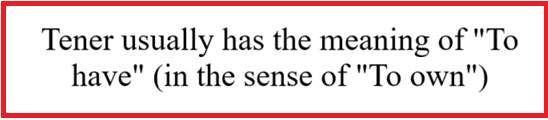
Tener = To have (typically in the sense of "To own")
First of all the verb tener means to have. It is often (but not exclusively) used to show ownership.
The verb tener in the present tense is as follows:
- tengo = I have
- tienes = You have (e.g. talking to one friend/one child)*
- tiene = It/He/She has + You have (e.g. talking to one stranger)**
- tenemos = We have
- tenéis = You have (e.g. talking to 2(+) friends/2(+) children)***
- tienen = They have + You have (e.g. talking to 2(+) strangers)****
Note:
* Tienes is the informal singular version of "you have". Tienes is the informal singular version of "you have".
** Tiene is the formal singular version of "you have". (It can also mean "he has", "she has" and "it has")
*** Tenéis is the informal plural version of "you have".
****Tienen is the formal plural version of "you have". (It can also mean "They have")
As explained above, tener is often used to show ownership. Some examples of possible usage are:
- Tengo una casa.
= I have a house. ("Tengo" here has the meaning of "I own")
- Tenemos un piso.
= We have an apartment. ("Tenemos" here has the meaning of "We own")
Tener que = To have to (in the sense of "must")
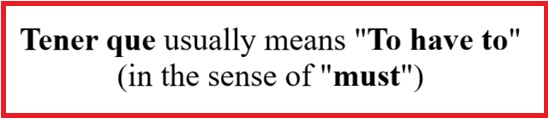
By contrast, putting the word "que" after tener changes the meaning. "Tener que" has the meaning of "To have to" (in the sense of "must").
Some examples of possible sentences using tener que are:
- Tengo que hablar.
= I have to talk. ("Tengo que" = "I have to" in the sense of "I must")
- Tenemos que comprar un coche.
= We have to buy a car. (i.e "Tenemos que" = "We have to" in the sense of "We must")
- Tienes que comer.
= You have to eat. ("Tienes que" = "You have to" in the sense of "You must")
You may have noticed from the examples above that after "tengo que", "tienes que" etc. the verb ends in ar, er or ir (i.e. hablar = to talk, comprar = to buy & comer = to eat). These verb forms are known as the infinitive form of the verb. The infinitive is the unchanged form of the verb, which you usually find in the dictionary. Examples are:
- hablar = to talk/to speak
- comer = to eat
- vivir = to live
In short, when you use "tengo que", "tienes que", etc. the verb that follows should end in ar*, er* or ir* (as can be seen in the examples above). Some useful infinitive examples are:
- salir (to go out)
- ir (to go)
- comer (to eat)
- hablar (to talk/to speak)
- comprar (to buy/to purchase)
*For more advanced learners: If your infinitive is a reflexive verb you would either put the reflexive pronoun at the end of the infinitive or alternatively in front of the first verb (e.g. Tengo que levantarme OR Me tengo que levantar = I have to get up/I must get up).
Deber = To have to (in the sense of "must")
Now that you have looked at the verb structures tener and tener que, let´s now look at the Spanish verb deber.
In short, the verb deber usually has more or less the same meaning as tener que. Deber usually* has the meaning of "to have to", usually in the sense of "must".
*For info, the verb deber can also mean "to owe".
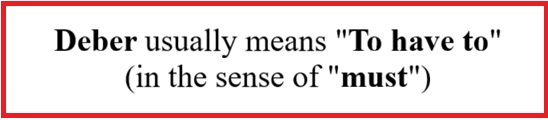
Essentially the tener que and deber are in principle interchangeable (in this context):
- Debo = Tengo que = I have to or must
- Debes = Tienes que = You have to or must (1 talking to friend/1 child)*
- Debe = Tiene que = He/She/It has to or must + You have to or must (talking to 1 stranger)*
- Debemos = Tenemos que = We have to or must
- Debéis = Tenéis que = You have to or must (talking to 2(+) friends/2(+) children)*
- Deben = Tienen que = They have to or must + You have to or must (talking to 2(+) strangers)*
Note:
* Tienes que/Debes are the informal singular versions of "you have to" and "you must".
** Tiene que/Debe are the formal singular versions of "you have to" and "you must". (They can also mean "he has to", "he must", "she has to", "she must", "it has to" and "it must")
*** Tenéis que/Debéis are the informal plural versions of "you have to" and "you must".
****Tienen que/Deben are the formal plural versions of "you have to" and "you must". (They can also mean "They have to" and "They must")
In this context the verbs forms from the verbs deber and tener que can in principle be substituted for each other whenever you like, for example:
- They must live in Spain or They have to live in Spain.
= Deben vivir en España or Tienen que vivir en España.
- I must speak or I have to speak.
= Debo hablar = Tengo que hablar.
- We must speak or We have to speak.
= Debemos hablar = Tenemos que hablar.
- She must learn or She has to learn.
= Debe aprender = Tiene que aprender.
Final note: This article has mainly used the translation "to have to" for "tener que" and "must" when using the present tense of the verb "deber". However, there is in principle no reason why "must" cannot be used for "tener que" and "have to" etc for "deber".
Spanish Language Tuition
Hopefully this article has been useful to you in understanding how you could use the Spanish verbs tener and deber (as well as the verb structure tener que).
To improve your Spanish further why not do Spanish tuition with the tutor who wrote this article? To get in contact click here or for more details on Spanish language tuition offered please click here.